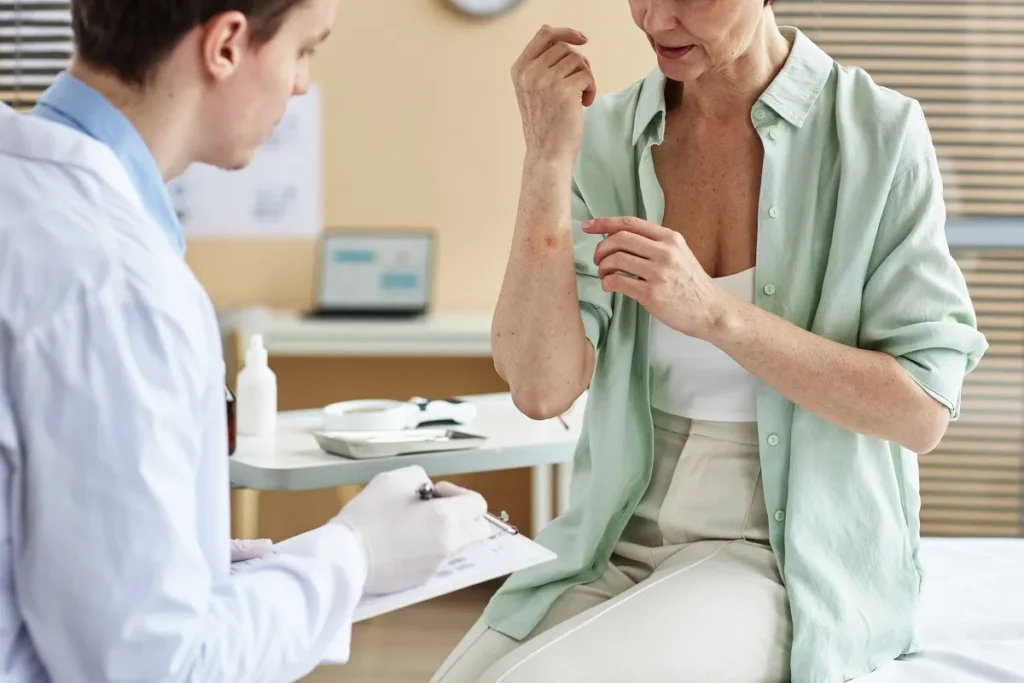
Disease Of Hair And Hair Follicles can be painful. Find the best medical relief for conditions like Hidradenitis Suppurativa and restore health.
Hidradenitis Suppurativa (HS) is a long-lasting skin condition. It causes painful, inflamed bumps in skin folds. The exact cause of HS is not known, leading to debate about its classification.
While many think of it as an autoimmune disease, new research shows it’s more complex.
Recent studies say HS is actually an autoinflammatory keratinization disease. This means it involves complex immune responses. People with HS often have other autoimmune diseases too, like inflammatory bowel disease and arthritis.
This suggests a link between HS and other autoimmune conditions.
Key Takeaways
Hidradenitis Suppurativa is not classified as a purely autoimmune disease.
HS is characterized by painful inflammatory lesions in skin folds.
Recent research suggests HS is an autoinflammatory keratinization disease.
Patients with HS often have concurrent autoimmune diseases.
The exact cause of HS remains unclear, with complex immune mechanisms involved.
Understanding Hidradenitis Suppurativa as a Disease of Hair Follicles

Hidradenitis Suppurativa is a unique disease that affects hair follicles. It also impacts apocrine sweat glands. This happens mainly in areas where skin folds or rubs together.
What is Hidradenitis Suppurativa?
Hidradenitis Suppurativa (HS) is a chronic inflammatory disease. It causes painful lesions and abscesses, often in the armpits, groin, and under the breasts. It’s known for its recurring nature and the formation of tunnels under the skin, called sinus tracts.
Pathophysiology and Affected Areas
The disease’s cause involves occluded hair follicles, apocrine gland issues, and an abnormal immune response. It mainly affects areas with apocrine glands. This leads to discomfort and can cause scarring and skin thickening over time.
It often affects the axillary, inguinal, and inframammary regions. But it can also happen in the scalp, making “hidradenitis suppurativa in scalp” a concern. The disease can cause a lot of pain, drainage, and secondary infections.
Common Symptoms and Disease Progression
HS symptoms range from mild to severe. They include painful nodules, abscesses, and draining sinus tracts. The disease goes through flare-ups and remission periods.
In the early stages, symptoms might be mild. But without treatment, HS can get worse. It can lead to widespread lesions and significant scarring.
Knowing how the disease progresses and its symptoms is key. Early diagnosis and treatment can help manage it. This improves the quality of life for those with HS.
The Relationship Between HS and Autoimmune Conditions

Recent studies have found a link between Hidradenitis Suppurativa (HS) and autoimmune diseases. This has shed new light on HS’s pathophysiology. We will explore how HS is related to autoimmune conditions, looking at its classification, prevalence, and immune system markers.
Current Classification: Autoinflammatory vs. Autoimmune
HS’s classification has changed, with some evidence suggesting it’s an autoinflammatory condition, not just an autoimmune disease. Autoinflammatory diseases have abnormal inflammation without autoantibodies or specific T cells. This makes them different from autoimmune diseases.
But, HS patients also show signs of autoimmune features. They have elevated levels of inflammatory cytokines, like in autoimmune diseases. This shows a mix of autoinflammatory and autoimmune mechanisms in HS.
Prevalence of Autoimmune Diseases in HS Patients
People with HS are more likely to have autoimmune diseases than others. They often have conditions like rheumatoid arthritis, systemic lupus erythematosus, and inflammatory bowel disease.
Rheumatoid arthritis is more common in HS patients, showing a shared inflammatory pathway.
Systemic lupus erythematosus is also linked to HS, possibly due to genetic factors.
Inflammatory bowel disease, including Crohn’s disease and ulcerative colitis, often occurs with HS, suggesting a common cause.
Elevated Autoantibodies in HS Patients
HS patients often have autoantibodies, which are antibodies against the body’s own tissues. This is a sign of autoimmune diseases.
Research shows HS patients have elevated levels of certain autoantibodies. This supports the idea that HS and autoimmune diseases share pathogenic mechanisms. The role of these autoantibodies in HS is being studied.
The role of autoantibodies in HS pathogenesis is being explored, with implications for diagnosis and treatment.
More research is needed to understand why HS patients produce autoantibodies.
In conclusion, the connection between HS and autoimmune conditions is complex. While HS is seen as an autoinflammatory condition, its link to autoimmune diseases and autoantibodies shows a complex interplay of immune system dysfunctions.
Conclusion: Implications for Diagnosis and Treatment
Seeing hidradenitis suppurativa (HS) as an autoinflammatory keratinization disease changes how we diagnose and treat it. This new view means we need to focus more on reducing inflammation. It’s a big shift in how we manage HS.
To control HS, we must tackle the inflammation at its source. HS is more than just an autoimmune disease. It involves many factors. Seeing it as an autoinflammatory condition helps us find better ways to treat it.
Why HS happens is something researchers are trying to figure out. But, it’s clear that some HS patients have autoimmune disease traits. Yet, autoantibodies don’t tell the whole story. Treatment should be made just for each person, based on their unique situation.
Healthcare providers can offer better care by taking a detailed approach to HS. They need to understand the disease’s complexities and tackle inflammation head-on. As research goes on, we’ll find new ways to help those with HS.
FAQ
Is Hidradenitis Suppurativa considered an autoimmune disease?
Hidradenitis Suppurativa is seen as an autoinflammatory keratinization disease. Yet, research points to a link with autoimmune conditions. Studies show a higher rate of autoimmune diseases in HS patients.
What is Hidradenitis Suppurativa?
Hidradenitis Suppurativa is a chronic skin condition. It causes recurring, painful abscesses and nodules in areas with apocrine glands. These areas include the armpits, groin, and buttocks. It leads to discomfort and emotional distress.
Is HS a hair follicle disorder?
Yes, Hidradenitis Suppurativa affects the hair follicles. It causes inflammation and occlusion of the follicles. This results in the characteristic lesions and symptoms.
What are the common symptoms of Hidradenitis Suppurativa?
Symptoms include painful nodules, abscesses, and tunnels under the skin. These are often accompanied by drainage and scarring. It also causes significant emotional distress, impacting quality of life.
How does Hidradenitis Suppurativa progress?
HS can progress from mild to severe. It involves recurring lesions, increasing pain, and scarring. This has a significant impact on daily life and overall well-being.
Are autoantibodies present in Hidradenitis Suppurativa patients?
Research shows some HS patients have elevated autoantibodies. This suggests a link between HS and autoimmune conditions. The exact mechanisms are unclear.
Can Hidradenitis Suppurativa occur on the scalp?
While less common, HS can occur on the scalp. It happens in areas with dense hair follicles. This leads to painful lesions and scarring.
Why does Hidradenitis Suppurativa happen?
The exact cause of Hidradenitis Suppurativa is not fully understood. It is believed to involve genetic, hormonal, and environmental factors. These lead to inflammation and occlusion of the hair follicles.
Is Hidradenitis Suppurativa an autoimmune condition?
While not classified as an autoimmune disease, HS shares characteristics with them. Research continues to explore the complex relationship between HS and autoimmunity.
How is Hidradenitis Suppurativa diagnosed and treated?
Diagnosis is based on clinical presentation and medical history. Treatment involves antibiotics, retinoids, and biologics. Lifestyle modifications are also used to manage symptoms and prevent flare-ups.
References
National Center for Biotechnology Information. Evidence-Based Medical Insight. Retrieved from https://www.ncbi.nlm.nih.gov/pmc/articles/PMC8860851/





