
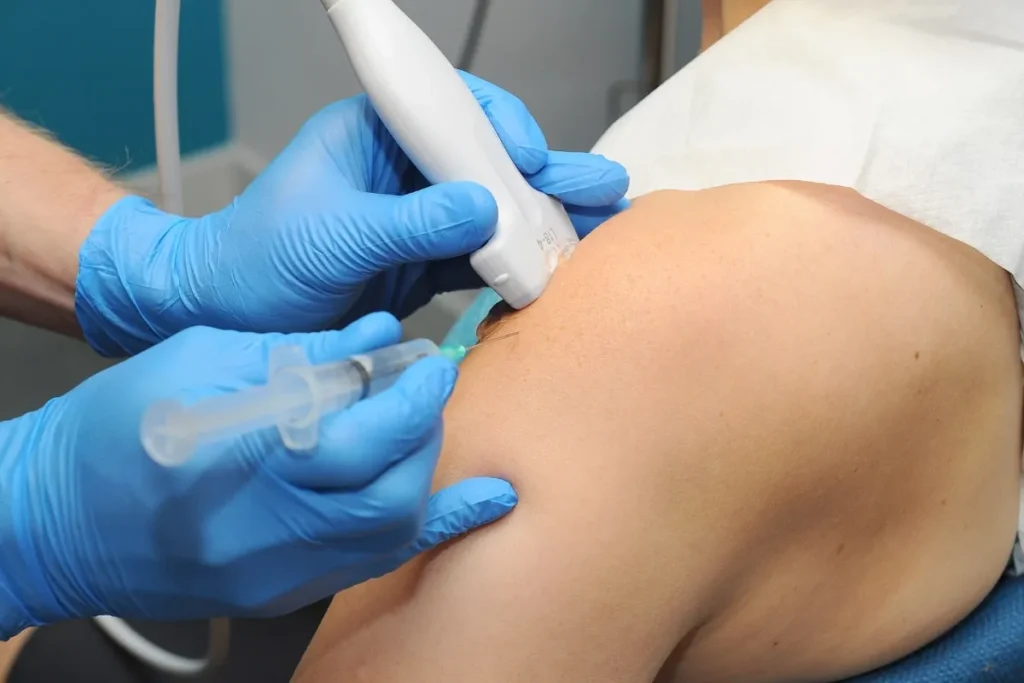
Myofascial pain, often caused by focal knots within skeletal muscle bands, can really affect our daily lives. Trigger point injections are a clinically-backed solution for dealing with tough muscle knots. They help restore our muscle function.
Healthcare professionals inject a local anesthetic or a mix of anesthetics and anti-inflammatory meds into the trigger point. This helps patients with myofascial pain find relief. Using ultrasound guidance makes these injections more accurate. This leads to better results and long-lasting pain relief for patients.
At GoldCity Center, we’re all about top-notch, evidence-based pain management. Our goal is to offer medical care that’s on par with the best around the world. This guide will walk you through the steps of trigger point injections. It’s all about giving patients the tools they need to manage their pain.
Key Takeaways
Trigger point injections are a therapeutic modality for addressing myofascial pain.
The procedure involves injecting a local anesthetic or a combination of anesthetics and anti-inflammatory medications.
Ultrasound guidance enhances the accuracy and precision of trigger point injections.
GoldCity Center is committed to providing high-quality, evidence-based interventional pain management.
Understanding the step-by-step guide on how to perform trigger point injections can empower patients to take control of their pain management.
Understanding Myofascial Pain and Trigger Points

It’s key to grasp the details of myofascial pain and trigger points for good treatment. Myofascial pain syndrome is a long-term issue that impacts the fascia, the tissue around muscles. It causes pain and swelling.
What Are Myofascial Trigger Points?
Myofascial trigger points are painful nodules within a taut band of fascia. This fascia is a connective tissue that wraps around muscles. These points can come from muscle overuse, injury, or stress. They lead to pain and discomfort in other areas.
Trigger points are tight muscle knots that hurt when touched. They can cause pain in other parts of the body. This makes finding the source of pain tricky without knowing about myofascial pain.
Clinical Indications for Trigger Point Therapy
Trigger point therapy, like injections, is for those with chronic myofascial pain that hasn’t gotten better with usual treatments. It’s for those with ongoing pain, limited movement, and stiff muscles.
Doctors check for trigger points by examining patients and looking at their history. Finding these points is key to figuring out the right treatment.
Evidence-Based Benefits of Injection Treatment
Studies show that trigger point injections can lower pain scores more than just medical care. Lidocaine in these injections helps a lot with pain relief.
Injection treatment for myofascial pain has proven benefits. It reduces pain, improves movement, and boosts life quality. By focusing on the trigger points, this therapy is a results-driven approach to managing myofascial pain syndrome.
Essential Preparation for Trigger Point Injections

Getting ready for trigger point injections is key. It involves the right tools and checking the patient’s health. This makes sure the treatment works well and is safe.
Required Equipment and Medications
Healthcare pros need special stuff for trigger point injections. They use syringes, needles, and medicines like lidocaine and corticosteroids. Trigger point injections might also use ultrasound to guide the needle.
The medicine choice depends on the patient’s needs and the doctor’s decision. Lidocaine eases pain, and corticosteroids cut down swelling.
Patient Assessment and Positioning
Checking the patient’s health before the injection is important. Doctors look at the patient’s history, find the trigger points, and plan the best way to inject. Studies show ultrasound-guided injections work better than blind ones.
How the patient is positioned is also key. They should be set up so the muscle with the trigger point is relaxed and easy to reach.
Safety Protocols and Contraindications
Following safety rules is a must to avoid risks with trigger point injections. This means using clean equipment, checking for any reasons not to do the injection, and knowing how to handle any problems that might come up.
Use sterile equipment to prevent infection
Assess patients for bleeding disorders or anticoagulant use
Be prepared for any complications
Safety rules help keep both the patient and the doctor safe. By sticking to these steps, the chance of bad side effects goes down a lot.
Performing Trigger Point Injections: Detailed Technique
Trigger point injections (TPI) are a key treatment for myofascial pain syndrome. They work well when done right, including finding and feeling trigger points and using ultrasound for better accuracy.
Locating and Palpating Trigger Points
Finding trigger points needs a good grasp of anatomy and skilled feeling. Trigger points are known by their tight band and twitch response. It’s important to know the difference between active and latent trigger points for effective treatment.
Examining the muscle carefully is part of the process. Techniques like flat or pincer palpation help find tender and tense areas. Spotting the right trigger point injection sites is key for success.
Ultrasound-Guided vs. Traditional Injection Methods
Ultrasound guidance has changed trigger point injections for the better. It makes the procedure more precise and safe. With ultrasound, you can see the needle and the area around it in real-time, lowering risks and improving results.
Traditional methods use landmarks and feeling to guide the needle. They work well but might not be as accurate, mainly in tricky spots. Whether to use ultrasound or traditional methods depends on the situation and the doctor’s choice.
Step-by-Step Injection Procedure
The step-by-step injection procedure includes several important steps:
Preparation: The patient is placed comfortably, and the skin is cleaned and prepared with antiseptic solution.
Identification: The trigger point is found through feeling, and its spot is marked.
Needling: The needle is put into the trigger point, and the medicine is injected.
Medication: Usually, a local anesthetic like lidocaine is used, sometimes with steroids.
The exact method might change based on the trigger point injection sites and the patient’s situation.
Post-Injection Management and Patient Instructions
After the injection, patients get post-injection instructions to avoid side effects and help with recovery. This includes not doing too much, using ice for soreness, and watching for infection signs.
Good post-injection management is vital for the best results and to avoid problems. By following these steps, doctors can make sure patients get the best care.
Conclusion
Trigger point injections are a proven way to tackle myofascial pain and get things working right again. Healthcare pros can follow a clear guide to give patients real relief. This helps patients feel better and do better.
Studies show that trigger point injections really help with pain and getting back to normal. Using lidocaine and steroids in these injections works well. It cuts down pain and swelling.
It’s key for patients to know how to manage their pain. Trigger point injections can change lives, making them pain-free. This lets patients reach their full capacity and feel better overall.
FAQ
What are trigger point injections used for?
Trigger point injections treat myofascial pain. This pain comes from painful nodules in a tight band of fascia. Fascia is a tissue that covers muscles.
What medications are typically used in trigger point injections?
Local anesthetics like lidocaine are often used. Sometimes, a mix of anesthetics and anti-inflammatory steroids is used too.
How do you locate trigger points for injection?
Finding trigger points involves feeling them and sometimes using ultrasound. This helps pinpoint the exact spot for the injection.
What is the role of ultrasound guidance in trigger point injections?
Ultrasound helps make the injections more precise. It lets doctors see the trigger point and the tissue around it. This ensures the medicine goes right where it’s needed.
What are the benefits of trigger point injections for myofascial pain?
These injections can greatly reduce pain for those with myofascial pain. They’re a good option for treating muscle knots and helping patients move better.
What is the typical recovery process after a trigger point injection?
After the injection, patients get instructions to help them recover. This includes avoiding hard activities and managing pain with medicine.
Can trigger point injections be used in conjunction with other treatments?
Yes, they can be used with other treatments like physical therapy. This gives patients a full care plan for their pain.
Are there any contraindications for trigger point injections?
Yes, some conditions might not be good for these injections. Doctors will check patients carefully to make sure they’re safe.
How do I know if I’m a good candidate for trigger point injections?
Talk to a healthcare professional. They can check your condition and decide if these injections are right for you.
What are the possible side effects of trigger point injections?
Side effects might include pain, bruising, or infection at the injection site. But, following safety steps and patient instructions can lower these risks.
Can trigger point injections be performed on any part of the body?
Yes, they can be done in different body areas. This includes the trapezius, paracervical, and lumbar regions, based on where the trigger point is.
How long does it take to experience relief from trigger point injections?
Relief times vary, but many feel better soon after. Improvement can keep getting better over time.
References
National Center for Biotechnology Information. Evidence-Based Medical Insight. Retrieved from https://pubmed.ncbi.nlm.nih.gov/31313700/