
Discover the revolutionary laser light therapy for hair loss. It’s a non-invasive treatment that stimulates hair growth. This therapy, also known as low-level laser therapy (LLLT) or photobiomodulation, has been clinically proven to be effective in treating androgenetic alopecia in both men and women.
By harnessing the power of red and near-infrared light, LLLT therapy promotes hair regrowth and improves density. This cutting-edge treatment is a game-changer for those seeking a non-surgical solution to hair loss.
With its clinically-proven effectiveness and non-invasive nature, laser light therapy is becoming a popular choice. It’s a great option for individuals looking to restore their confidence and achieve a fuller head of hair.
Key Takeaways
Laser light therapy is a non-invasive treatment for hair loss.
LLLT therapy stimulates hair growth and improves density.
Clinically proven to be effective in treating androgenetic alopecia.
Red and near-infrared light promotes hair regrowth.
A non-surgical solution for hair loss.
Understanding Laser Light Hair Restoration Technology

Laser light hair restoration technology works by using photobiomodulation to stimulate hair growth. This method is non-invasive and has gained attention for treating hair loss.
What is Low-Level Laser Therapy (LLLT)?
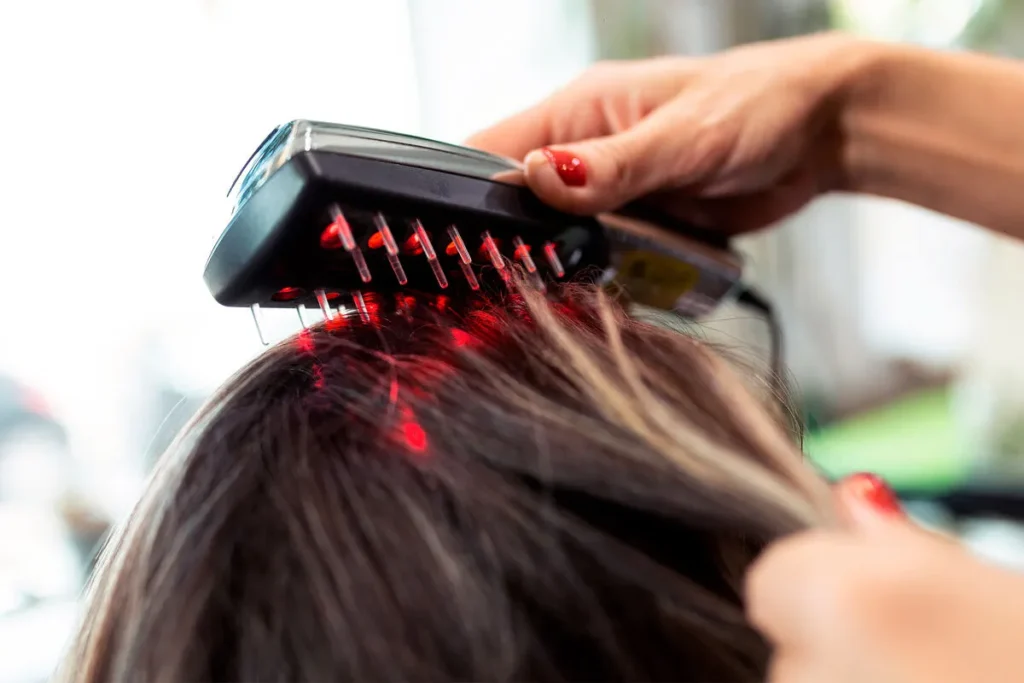
Low-Level Laser Therapy (LLLT) is a treatment that uses low-level laser or light-emitting diodes. It stimulates hair growth without surgery. LLLT devices emit a specific wavelength of light that boosts hair follicle activity.
LLLT works by stimulating hair bulge stem cells through photobiomodulation. This process increases hair density by promoting cellular growth and activating the hair cycle.
How Photobiomodulation Stimulates Hair Growth
Photobiomodulation uses light to stimulate cells. For hair growth, it involves light absorption by mitochondria in hair follicle cells. This increases energy production and stimulates hair growth.
Increased ATP production: Light absorption enhances mitochondrial function, leading to increased ATP production, which is vital for hair growth.
Enhanced cellular proliferation: The energy boost from ATP promotes the growth of hair follicle cells.
Activation of the anagen phase: Photobiomodulation helps in transitioning hair follicles from the resting phase to the active growth phase.
Clinical Evidence and Success Rates
Clinical studies have shown LLLT’s effectiveness in promoting hair growth. A notable study found that LLLT can increase hair density by up to 17%. This makes it a promising treatment for hair loss.
Success rates of LLLT vary, but it is seen as a promising solution for hair loss. Success depends on the severity of hair loss, treatment consistency, and individual response to therapy.
Step-by-Step Guide to Using LLLT Devices

To get the most from laser light therapy for hair loss, knowing how to use LLLT devices is key. With the right steps, you can enjoy the benefits of this easy treatment.
Types of FDA-Approved Devices
There are many LLLT devices out there, like laser caps and combs. Make sure to pick one that’s FDA-approved and fits your needs. Here are some top choices:
Laser caps that cover the whole scalp
Laser combs for focused treatment
Handheld devices for spot treatments
Proper Application Techniques
Getting the application right is vital for laser therapy for hair growth. First, clean and dry your scalp. For laser caps, just wear them for 20-30 minutes as told. For laser combs, comb through your hair gently, making sure the laser hits your scalp.
Recommended Treatment Schedule
Being consistent is key in laser hair loss therapy. Most devices suggest using them 2-3 times a week. Some need daily use. Always stick to the maker’s schedule for best results.
Safety Considerations and Side Effects
LLLT devices are mostly safe, with rare side effects. But, it’s important to follow the maker’s advice and not overdo it. Some might get mild scalp irritation, but it usually goes away by itself.
By following this guide, you can use LLLT devices well. This will help promote hair growth and get the best from your laser light treatment for hair.
Conclusion: Optimizing Your Laser Therapy Results
Consistency is key when using laser light therapy for hair loss treatment. Understanding how Low-Level Laser Therapy (LLLT) works is important. Following a proper treatment schedule helps achieve the best results with laser hair growth treatment.
Laser light hair therapy has been clinically proven to stimulate hair growth. With the right device and application technique, you can see significant improvements in hair density and texture. So, does laser light work for hair growth? Yes, it does, when used consistently and as directed.
To get the most out of hair loss treatment laser therapy, patience and commitment are essential. A consistent routine and the right mindset help unlock your full hair growth. This way, you can achieve a radiant, healthy-looking mane.
By elevating your routine and embracing laser light therapy, you can start your journey to a fuller, more vibrant head of hair. Your glow-up story starts here. With the right tools and techniques, you can own your beauty and slay the day with radiant skin and a confident smile.
FAQ
What is laser light therapy for hair loss?
Laser light therapy is a non-invasive treatment. It uses low-level laser or light-emitting diodes to stimulate hair growth. It also slows down hair loss.
How does laser light therapy work for hair regrowth?
It increases blood flow to the scalp, promoting hair growth. It also reduces inflammation. The light emitted by the laser or LEDs is absorbed by hair follicles, making them produce thicker, healthier hair.
Is laser light therapy for hair loss clinically proven?
Yes, it is clinically proven. Studies show it increases hair density, thickness, and growth rate. The FDA has cleared it for treating androgenetic alopecia.
What are the benefits of using laser light therapy for hair loss?
It’s non-invasive, has minimal side effects, and is clinically effective. It can be used with other treatments, like medications or hair transplantation.
How often should I use laser light therapy for hair loss?
Treatment frequency depends on the device and your hair loss condition. Usually, treatments are needed several times a week. Each session lasts about 15-30 minutes.
Are there any side effects associated with laser light therapy for hair loss?
It’s generally safe, with few side effects. Some users might experience mild scalp irritation or redness. These effects are usually temporary.
Can I use laser light therapy for hair loss at home?
Yes, there are at-home devices like caps, helmets, and combs. They are designed to be easy to use and fit into your daily routine.
How long does it take to see results from laser light therapy for hair loss?
Results vary by individual and device. Some see improvements in a few months, while others may take longer.
Can laser light therapy be used in conjunction with other hair loss treatments?
Yes, it can be used with other treatments like medications, hair transplantation, or PRP therapy. Combining treatments may enhance results and improve hair health.
Is laser light therapy for hair loss suitable for everyone?
It’s suitable for most experiencing hair loss or thinning. But, it’s important to consult a healthcare professional before starting. This is true if you have any medical conditions or are using other treatments.
References
National Center for Biotechnology Information. Evidence-Based Medical Insight. Retrieved from https://pmc.ncbi.nlm.nih.gov/articles/PMC3944668/[1


