

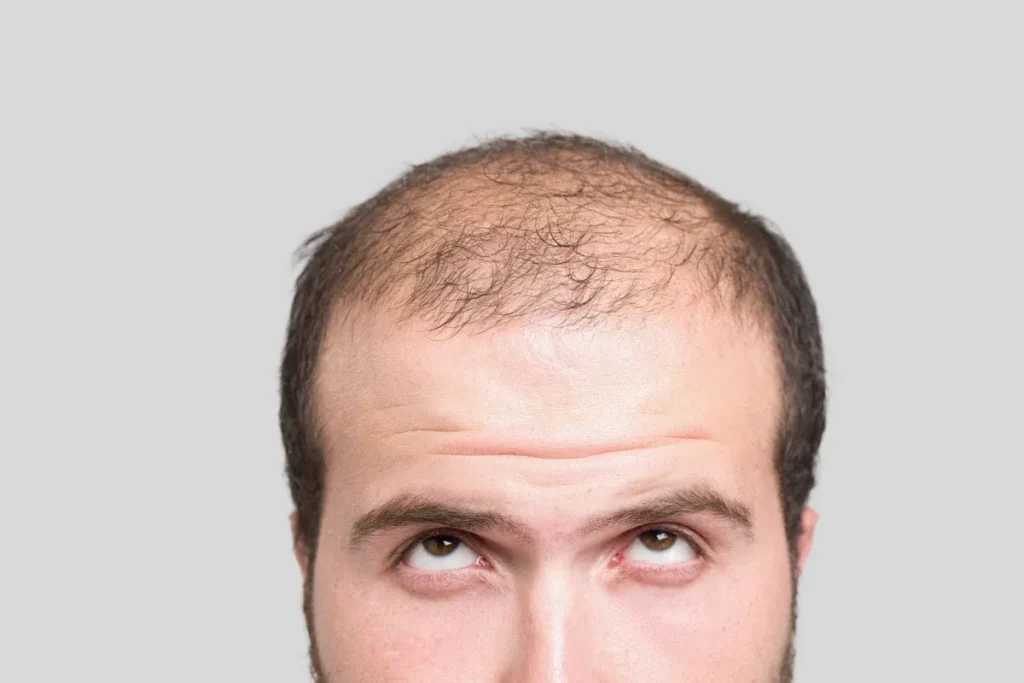
Male pattern baldness affects millions of men globally. By age 50, over half of all men face some androgenetic alopecia. Knowing how it progresses is key to effective treatment. The Norwood Scale categorizes male pattern baldness into seven stages.
Stage 1 hair loss is the best time to act. Discover an essential early fix and powerful ways to prevent further thinning and balding.
At GoldCity Center, we use the latest in dermatology and focus on the patient. This helps people understand their hair loss journey. Recognizing early signs through the Norwood Scale lets people choose the right treatment.
Key Takeaways
Understanding the Norwood Scale is vital for tackling male pattern baldness.
The Norwood Scale breaks down male pattern baldness into seven stages.
Early action is essential for good treatment.
GoldCity Center offers top-notch dermatology and patient care.
Spotting early signs of male pattern baldness helps people make better choices.
Understanding Male Pattern Baldness and the Norwood Scale

To tackle male pattern baldness, it’s key to grasp the Norwood Scale. This condition, also known as androgenetic alopecia, affects millions of men. It impacts not just looks but also mental health.
What is Androgenetic Alopecia?
Androgenetic alopecia is a genetic hair loss condition. It happens when hair follicles are sensitive to androgen hormones. This sensitivity makes hairs thinner and shorter, leading to hair loss.
This condition worsens over time. It’s shaped by genetics and hormones.
History and Development of the Norwood Classification
The Norwood Scale was first created by Medical Expert 1950s. Medical Expert’Tar Norwood refined it in 1975. It’s a way to measure male pattern baldness.
The scale has seven stages, from minimal to extensive hair loss. Knowing its history helps us understand its importance in treating hair loss.
Prevalence and Genetic Factors
By 50, over 50% of men have noticeable hair loss. By their 50s, about 85% show signs of baldness. Genetics are a big factor in male pattern baldness.
Men with a family history of baldness are more likely to lose their hair. The high prevalence of this condition shows the need for effective treatments.
Understanding the Norwood Scale and the factors behind male pattern baldness is vital. It helps men take early action and understand their genetic predisposition. This knowledge empowers them to manage their hair loss and seek treatment options.
Stage 1 Hair Loss Through Advanced Baldness: The Complete Norwood Scale

Hair loss can be divided into seven stages, as shown by the Norwood Scale. This system helps people understand how much hair they’ve lost. It also guides them in choosing the right treatment.
Early Progression: Norwood 1-2
The first two stages, Norwood 1 and Norwood 2, show minimal to moderate hair loss. The hairline may start to recede, and hair thinning around the temples becomes noticeable. At this point, treatments like medical therapy can slow hair loss and encourage new growth.
Moderate Hair Loss: Norwood 3-4
Stages Norwood 3 and Norwood 4 see the hairline recede further and hair thinning increase. The top of the scalp may show significant balding. At this stage, treatments like hair restoration surgery may be considered to cover bald spots.
Advanced Baldness: Norwood 5-7
The final stages, Norwood 5 to Norwood 7, show extensive balding. Norwood 5 has more hair loss on the vertex and a receding hairline. Norwood 6 and Norwood 7 have almost or complete baldness on the scalp’s top. Treatments at these stages often combine medical therapy and surgery for the best results.
Knowing the details of each Norwood Scale stage is key to finding the right treatment. By identifying their stage, people can choose the best treatment. This can lead to better hair density and appearance.
Conclusion: Identifying Your Norwood Stage and Next Steps
Knowing your spot on the Norwood Scale is key to fighting hair loss. By figuring out your Norwood stage, you can find treatments that fit your needs.
Clinics like Solve Clinics and RESTORE Hair use the Norwood Scale for custom hair treatments. They make sure you get the right solutions for your hair loss.
If you see early signs of baldness or are losing a lot of hair, knowing your Norwood stage is the first step. It helps you regain confidence and get a fuller head of hair.
Talking to a professional can help you understand your baldness better. They can guide you to the best treatments. With the Norwood Scale, you can find many options to make you look and feel better.
FAQ
What is the Norwood Scale, and how is it used to classify male pattern baldness?
The Norwood Scale is a system used to measure male pattern baldness. It has seven stages, from a little hair loss to complete baldness. This helps people understand their hair loss and choose the right treatment.
What are the different stages of the Norwood Scale, and how do they progress?
The Norwood Scale has seven stages. These range from minimal hair loss to complete baldness. The stages go from Norwood 1 to Norwood 7, showing how hair loss gets worse.
What is the difference between Norwood 2 and Norwood 3?
Norwood 2 shows a slight hairline recession with some hair loss. Norwood 3 has a more noticeable “M” shape in the hairline.
Can hair loss be reversed, and what are the most effective treatment options?
Hair loss can’t always be reversed, but treatments can slow it down. Options include medical therapy, hair restoration, and treatments like low-level laser therapy (LLLT) or platelet-rich plasma (PRP) therapy.
How does genetics play a role in male pattern baldness, and can it be predicted?
Genetics greatly affect male pattern baldness. Certain traits increase the risk of hair loss. While predicting hair loss is hard, knowing your family history can help you take action.
What is the prevalence of male pattern baldness, and how common is it?
Male pattern baldness is common, affecting many men worldwide. It’s estimated that up to 80% of men will lose some hair by age 80.
How can I determine my Norwood stage, and what are the next steps?
To find your Norwood stage, see a dermatologist or hair specialist. They can assess your hair loss and suggest a treatment plan. This plan will be based on your specific needs and goals.
References
National Center for Biotechnology Information. Evidence-Based Medical Insight. Retrieved from https://pmc.ncbi.nlm.nih.gov/articles/PMC5596658/[7


