

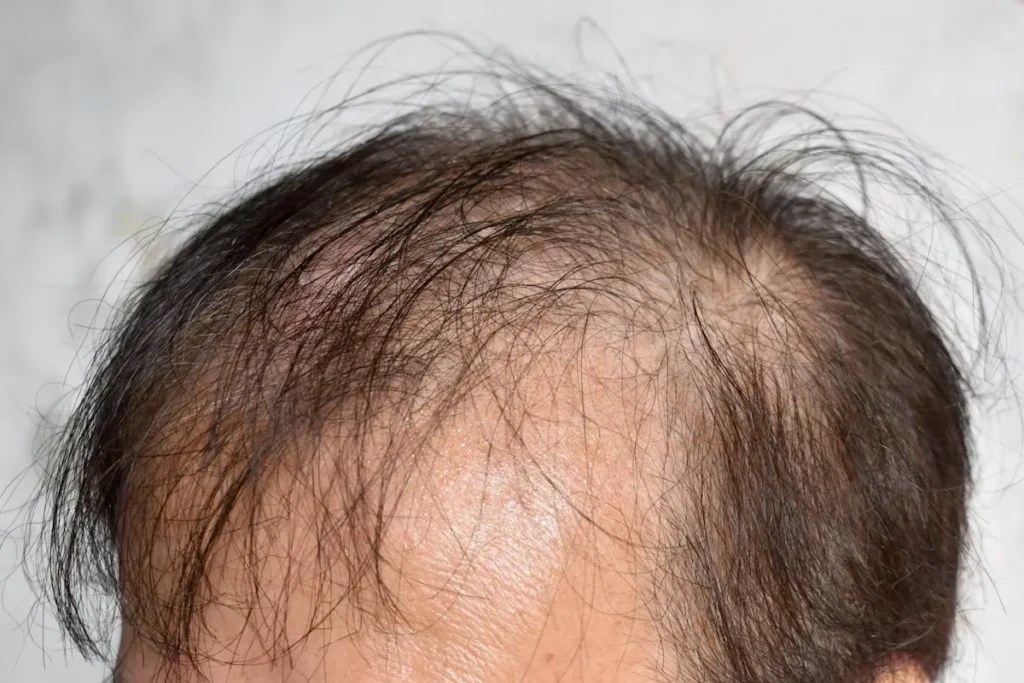
Male pattern baldness is common among men by midlife. Knowing how much hair you’ve lost is key to finding the right treatment. The Norwood Scale breaks down male pattern baldness into seven stages.
Medical Expert. O’Tar Norwood created this scale. It helps diagnose and track hair loss clearly. By knowing your Norwood Scale stage, you can find the best treatment for your hair loss.
Stage 4 baldness is reversible! Explore the best effective ways and powerful transplants to achieve an amazing, full head of hair again.
Key Takeaways
The Norwood Scale classifies male pattern baldness into seven stages.
It provides a clear framework for understanding the progression of hair loss.
Understanding your Norwood Scale stage is key to choosing the right treatments.
The scale was developed by Medical Expert. O’Tar Norwood.
Knowing your stage helps in making informed decisions about your hair loss treatment.
Understanding Male Pattern Baldness and the Norwood Scale

Understanding male pattern baldness is key to finding effective treatments. The Norwood Scale is a big help in this area. It helps doctors see how bad the hair loss is.
Male pattern baldness, also known as androgenetic alopecia, is a common issue. It affects millions of men around the world.
What is Androgenetic Alopecia?
Androgenetic alopecia is a hereditary condition. It makes hair thin and fall out, mainly on the scalp. This happens because of a hormone change.
Medical Expert, renowned researcher on hair loss
Over time, it leads to more hair loss. This is most noticeable at the temples and crown. Catching it early can help slow it down.
History and Development of the Norwood Scale
The Norwood Scale was created by Medical Expert. O’Tar Norwood. It helps measure how much hair loss a man has.
The Norwood Scale is now the top way to diagnose and track male pattern baldness.
Prevalence and Statistics
Male pattern baldness is common among men. About 60% of men start to lose a lot of hair by their mid-30s.
By age 30, about 30% of men show some signs of balding.
By age 50, this number jumps to around 50%.
By age 70, nearly 80% of men have some hair loss.
Knowing these numbers helps doctors diagnose and plan treatments better.
Early Stages of Hair Loss: Norwood Stages 1-3

The early stages of hair loss, as defined by the Norwood Scale, are key to understanding male pattern baldness. Knowing these stages helps people see where they are with hair loss. It also guides them in choosing the right treatments.
Stage 1: Minimal or No Hair Loss
At Stage 1, there is minimal or no hair loss. The hairline is intact, and there are no clear signs of balding. People with a full head of hair or a slight recession fit into this category. It’s important to remember that some people naturally have a receding hairline or uneven hair density. But these don’t mean they’re balding.
Stage 2: Minor Recession at the Temples
Stage 2 shows minor recession at the temples. This is where the hairline starts to recede, and it’s symmetrical. It might be more obvious when you compare old photos. The hair loss is small, but it’s a sign that balding could be starting.
Stage 3: First Signs of Clinical Baldness
Stage 3 is when the first signs of clinical baldness appear. The hair loss is more noticeable. The hairline starts to form an ‘M’ shape due to hair loss around the temples and crown. This is when balding becomes visible and it’s time to think about treatments.
Knowing about these early stages helps people take action against hair loss. They can try medical treatments, change their lifestyle, or explore other options. Recognizing balding early can greatly help in managing it.
Stage 4 Baldness: The Critical Turning Point
Stage 4 hair loss marks a turning point where balding becomes more obvious. At this stage, people see a lot of hair loss at the front and the crown. The bald spots become clearer.
Identifying Stage 4 Hair Loss Patterns
To spot Stage 4 hair loss, look at the front and crown areas. The hair loss is more noticeable, showing a clear difference between bald spots and the hair that remains.
Key characteristics include:
A more defined frontal hairline recession
Significant thinning or balding at the crown
A distinct separation between the balding areas and the remaining hair
Frontal and Crown Balding Characteristics
At Stage 4, the balding at the front and crown is more obvious. The front hairline recedes more, and the crown thins out a lot.
The characteristics of frontal and crown balding at this stage include:
Increased visibility of the scalp due to hair thinning
A horseshoe-shaped hair pattern starting to form
More pronounced balding areas
Treatment Options for Stage 4
For those at Stage 4, several hair loss treatment options are available. These include:
Medications: FDA-approved meds like minoxidil and finasteride can slow hair loss and boost growth.
Low-Level Laser Therapy (LLLT): LLLT devices help by boosting blood flow to the scalp.
Hair Transplantation: A surgical method that moves healthy hair follicles to bald spots.
It’s important to talk to a healthcare pro or dermatologist to find the best treatment for Stage 4 baldness.
Advanced Hair Loss and Variants
The Norwood Scale categorizes advanced hair loss into distinct stages. It helps us understand how balding progresses.
Stage 5: Increased Hair Loss with Larger Bald Areas
At Norwood stage 5, hair loss is more noticeable. Larger bald areas appear on the scalp. The hairline and crown areas thin out.
This stage shows a big increase in hair loss. It leads to a clear balding pattern. People may see a big change in their hairline and density.
Stage 6: Bridge of Hair Connecting Sides Disappears
Norwood stage 6 is a key point in male pattern baldness. The hair bridge between the scalp sides vanishes. This leaves a bigger bald area covering the front and crown.
Hair loss at this stage is more widespread. The remaining hair may become finer and less dense.
Stage 7: Only Horseshoe Pattern Remains
The most advanced stage is Norwood stage 7. Only a horseshoe pattern of hair remains on the sides and back. The bald area is huge, and hair is mostly found in the temporal and occipital regions.
This stage is the most severe male pattern baldness. It has big implications for treatment and management.
Type A and Type V Variants
There are variants of the Norwood Scale too. The Type A variant has vertex balding in the front. The Type V variant shows a more severe balding pattern.
Knowing these variants is key for diagnosing and treating male pattern baldness.
Conclusion
The Norwood Scale helps us understand male pattern baldness. It lets people know how to deal with hair loss. By knowing the stages, they can find the right treatment.
The Norwood Scale shows hair loss from a little to a lot. Knowing these stages helps in treating hair loss well. This leads to a better understanding and confidence in how one looks.
Understanding the Norwood Scale is the first step in fighting hair loss. It helps people find the right treatments. They can make smart choices about their hair journey.
Starting a journey to restore hair can make a big difference. The Norwood Scale is a key tool. It guides people through understanding and treating male pattern baldness.
FAQ
What is the Norwood Scale?
The Norwood Scale is a way to measure male pattern baldness. It has seven stages, from no hair loss to full baldness.
What is male pattern baldness?
Male pattern baldness, or androgenetic alopecia, is a common issue. It causes hair loss due to hormones and genetics.
What are the early signs of hair loss according to the Norwood Scale?
The early signs are stages 1-3. These show minimal hair loss, slight temple recession, and the first signs of baldness.
What is Stage 4 baldness?
Stage 4 is a big step in male pattern baldness. It shows hair loss at the front and crown, with clear bald spots.
What are the treatment options for Stage 4 baldness?
For Stage 4, treatments include medicines, hair transplants, and low-level laser therapy. These aim to slow hair loss and grow new hair.
What are the advanced stages of hair loss according to the Norwood Scale?
Advanced stages are 5, 6, and 7. Each is more severe, with stage 7 being the most advanced.
What is the difference between Type A and Type V variants of hair loss?
Type A and Type V show different hair loss patterns. Type A is more front-focused, while Type V has a larger bald area.
Can hair loss be reversed?
Hair loss can’t be fully reversed. But, treatments can slow it down or even grow new hair, depending on the case.
How does the Norwood Scale help in addressing male pattern baldness?
The Norwood Scale helps by classifying male pattern baldness clearly. It lets people understand their condition and find the right treatments.
References
National Center for Biotechnology Information. Evidence-Based Medical Insight. Retrieved from https://pmc.ncbi.nlm.nih.gov/articles/PMC5596658/[7


