

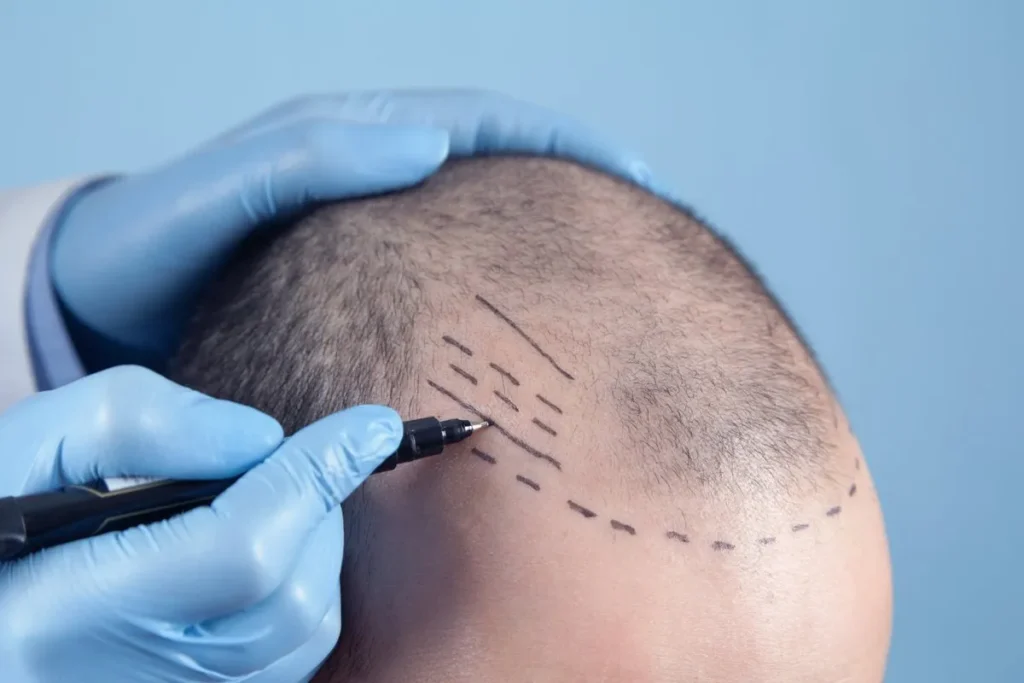
Losing all your hair can feel like a big setback. But, modern hair restoration tech offers new hope, even for total baldness. At GoldCity Center, we’re dedicated to top-notch, ethical healthcare. We look at each case to find the best treatment.
If you have healthy donor hair left, you might be a transplant candidate. The International Society of Hair Restoration Surgeons says a lot of donor hair comes from the back and sides. This makes a good solution for many.
Nonsurgical treatments like PRP and hair loss meds can wake up dormant follicles. This can give you enough donor area for a transplant. So, even with a lot of hair loss, you can look into restoration options.
Key Takeaways
A hair transplant is an option for those who are completely bald, if there’s enough donor hair.
Having healthy donor hair is key to seeing if you can get a hair transplant.
Nonsurgical treatments can wake up dormant follicles, making more donor area.
Modern hair restoration tech gives hope to those with total baldness.
Getting a personalized evaluation is important to find the best hair restoration plan.
Understanding Complete Baldness and Hair Restoration Options

Advances in hair restoration offer hope for those facing total baldness. It’s not just a late stage of hair loss. It’s a unique condition needing a special approach to fix.
Defining Total Baldness vs. Advanced Hair Loss
Total baldness means no hair on the scalp. Advanced hair loss has some hair, but it’s very thin. Knowing the difference helps pick the right hair restoration plan.
The Norwood Scale helps measure hair loss. But it doesn’t cover complete baldness. This means a detailed check is needed for hair transplant options.
The Basic Requirements for Hair Transplant Candidacy
To qualify for a hair transplant, several things are checked:
The extent and pattern of hair loss
The availability of donor hair, typically from the back and sides of the scalp
The overall health of the patient
Realistic expectations regarding the outcome of the procedure
The average number of grafts from the safe donor area is 4,000 to 6,500. This is key for those with complete baldness.
Experts say, “A detailed consultation is vital. It helps figure out if you’re a good candidate and what plan suits you best.”
Understanding total baldness and what’s needed for a hair transplant helps make better choices. This way, individuals can find the right hair restoration option for them.
Donor Hair Availability for Totally Bald Hair Transplant Candidates

Total baldness doesn’t mean you can’t get a hair transplant. Thanks to new ways to find donor hair, it’s possible. The success of a transplant depends on finding good donor hair.
Scalp Donor Areas: Limitations and Possibilities
For a long time, the scalp was the main place to find donor hair. But for those who are totally bald, finding enough healthy hair is hard. “Finding enough donor hair is a big challenge,” says Medical Expert, a top hair restoration expert.
Even with less hair, new transplant methods can help a lot. The trick is to use the hair you have wisely. This means careful planning and precise transplanting.
Alternative Donor Sources: Beard and Body Hair
If you don’t have enough scalp hair, you might consider using beard or body hair. Beard hair is strong and thick, making it a good choice.
Body hair transplantation (BHT) is another option when all else fails. It works best if the body hair matches your scalp hair well.
Key considerations for alternative donor sources include:
The quality and quantity of the donor hair
The patient’s overall hair loss pattern and desired outcome
The expertise of the hair restoration specialist in utilizing alternative donor sources
Looking at both traditional and new donor sources opens up hair transplantation for those who are totally bald. It’s a chance to regain your hair.
Realistic Expectations and Success Rates
If you’re thinking about hair restoration, knowing the success rates and what to expect is key. Hair transplantation is now a real option for those with total baldness. It offers a chance to get a full head of hair back.
Average Graft Numbers and Coverage
The number of grafts needed for a successful hair transplant for male pattern baldness varies. It can range from 1,000 to 3,000 grafts. This depends on how bald you are and how much hair you want.
How much hair you can get back also depends on the donor hair you have. If you’re totally bald, doctors might use hair from your beard or body to get the right density.
Clinical Outcomes and Patient Satisfaction
Studies show that hair transplantation works well, even for those with advanced baldness. About 94% of patients are happy with their results 12 months after surgery. This shows how good modern hair restoration is.
The success of the surgery also depends on the surgeon’s skill and how well you recover. It’s important to choose a skilled and experienced surgeon for the best results.
Aesthetic Results in Advanced Baldness Cases
Getting bold hair restoration means understanding hairline design and where to place grafts. For advanced baldness, the goal is to create a natural-looking hairline. This should frame your face and improve your look.
The success of hair surgery for balding isn’t just about how many grafts you get. It’s also about how natural and good-looking the results are. A successful surgery can boost your confidence and improve your life quality.
Conclusion: Making an Informed Decision About Hair Transplants for Complete Baldness
For those with complete baldness, getting a full head of hair again seems hard. But, hair transplant technology has improved a lot. Now, many can see big changes, even if they can’t get a full head back.
It’s key to know who can get a hair transplant. People with complete baldness might use beard or body hair. This opens doors for those who were once not considered.
So, can you get a hair transplant if you’re bald? Yes, but you should know what to expect. Studies show that hair transplants work well, even for those with a lot of baldness.
Choosing to get a hair transplant is a big decision. It’s important to think about your situation and what you want. Knowing your options and what might happen can help you feel more confident and get a hairline that looks natural.
FAQ
Can I get a hair transplant if I’m completely bald?
Yes, you can get a hair transplant even if you’re bald. But, it depends on if you have enough donor hair.
What is the difference between total baldness and advanced hair loss?
Total baldness means you have no hair on your scalp. Advanced hair loss means you have thinning or balding, but not all hair is gone.
What are the basic requirements for hair transplant candidacy?
To get a hair transplant, you need enough donor hair. This can come from your scalp or other areas like your beard or body.
Can I use body hair for a hair transplant?
Yes, you can use body hair for a transplant. It’s a good option if you don’t have enough hair on your scalp.
What are the success rates for hair transplantation in cases of complete baldness?
Success rates vary. They depend on the quality of your donor hair, how many grafts you need, and your surgeon’s skill. But, many people see great results.
How many grafts are typically needed for a full head hair transplant?
The number of grafts needed varies. It depends on how bald you are and how much hair you want. On average, you might need 2,000 to 5,000 grafts for a full head.
Can I achieve a natural-looking hairline with a hair transplant?
Yes, with the right surgeon and enough donor hair, you can get a natural-looking hairline. It can really improve how you look.
Are there any risks associated with hair transplantation for the completely bald?
Like any surgery, there are risks. But, a good surgeon can make sure the transplant is safe and successful.
How long does it take to see the final results of a hair transplant?
Seeing the final results takes time. It can take months to a year or more. This is because the transplanted hair grows naturally.
Can I get a hair transplant if I’ve had previous hair restoration surgery?
Yes, you can get another transplant if you’ve had surgery before. But, you should talk to a qualified surgeon first to figure out what’s best.
References
National Center for Biotechnology Information. Evidence-Based Medical Insight. Retrieved from https://pmc.ncbi.nlm.nih.gov/articles/PMC6967160/


