
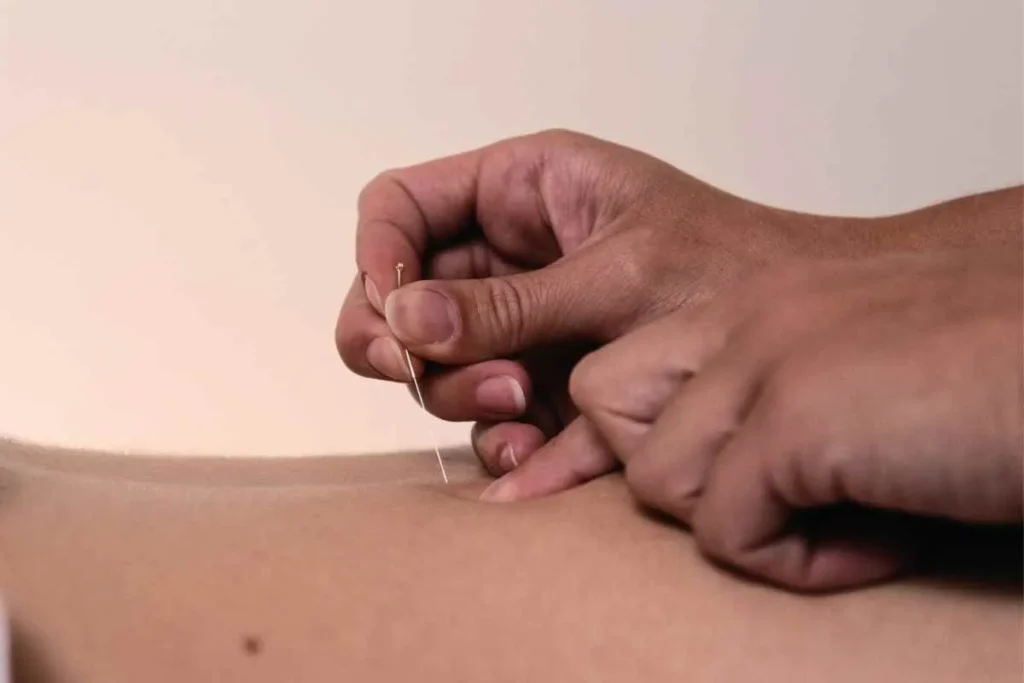
Acupuncture, known as in Chinese, is a healing practice with deep roots in traditional Chinese medicine (TCM). It has a history of thousands of years. This ancient practice has grown into a complex system that looks at health and wellness in a whole way.
The origin of acupuncture is based on the philosophies of Confucianism and Taoism. These reflect China’s cultural heritage. Today’s accupuncturists keep this tradition alive with updated techniques and science-backed methods. They honor both the tradition and the science of these practices.
Belangrijkste opmerkingen
Acupuncture is rooted in traditional Chinese medicine and philosophy.
It has evolved over thousands of years into a sophisticated healing practice.
Modern practitioners blend ancient techniques with contemporary evidence-based methods.
The practice is deeply connected to Chinese cultural heritage.
Acupuncture embodies a holistic approach to health and wellness.
The Ancient Roots of Chinese Acupuncture

The history of Chinese acupuncture is filled with ancient traditions and medical breakthroughs. It has deep roots in China’s past, going back thousands of years.
Neolithic Beginnings and Archaeological Evidence
Studies show that acupuncture practices started in the Neolithic period. People used stones and bones for treatments back then. Records say acupuncture began in China around 2500 BCE.
Old artifacts and medical tools have given us a peek into Asian acupuncture’s early days. They help us see how this complex system evolved.
The Yellow Emperor’s Classic of Internal Medicine
The first detailed guide to acupuncture is The Yellow Emperor’s Classic of Internal Medicine, from about 100 BCE. It explains acupuncture techniques and meridians, setting the stage for today’s practice.
The Huangdi Neijing (The Yellow Emperor’s Classic of Medicine), written around 200 BCE, is key to traditional Chinese medicine. It talks about the body’s energy paths and how to fix Qi flow.
Looking at these key moments, we see how acupuncture grew into a complex medical system. It has lasted for centuries. Today, Chinese acupuncture shapes modern medicine, giving a special view on health and wellness.
How Acupuncture Originated in Traditional Chinese Philosophy

Acupuncture’s roots in traditional Chinese philosophy are key to understanding it. It’s based on ancient Chinese thought. This thought focuses on balancing opposing forces and the flow of vital energy.
The theory behind acupuncture comes from ancient Chinese philosophy. It’s based on yinyang balance and the flow of Qi through meridians. For more on Chinese medicine, including acupuncture and moxibustion, check out this resource.
The Concept of Yin and Yang Balance
The balance between yinyang is vital for health. Yin is about being receptive, cold, and dark. Yang is about being creative, warm, and light. Acupuncture works to balance these opposing forces.
Yin aspects include receptivity and coldness.
Yang aspects include creativity and warmth.
When yinyang is balanced, the body is healthy. Acupuncture helps keep this balance by stimulating specific points along the meridians.
Qi Energy and Meridian Pathways
The idea of Qi energy is at the heart of acupuncture. Qi is the life energy that flows through the body. It moves through specific pathways called meridians.
The flow of Qi is key for health.
The twelve meridians are linked to organs like the heart and lungs.
Acupuncture aims to keep Qi flowing smoothly by stimulating certain points.
Understanding Qi flow and yinyang balance helps practitioners use acupuncture. They can restore health and well-being this way.
Evolution and Standardization of Acupuncture Practice
As acupuncture spread, it became more refined and standardized. The Ming Dynasty (1368-1644 AD) was a key time for this. Practitioners like Jizhou Yang documented a complete system of 365 acupoints.
Ming Dynasty Practitioners
The Ming Dynasty was a turning point for accupuncutre. It saw the start of acupuncture schools and better techniques. Practitioners of this time helped standardize acupoints and methods, setting the stage for today’s practice.
Refinement of acupuncture needles led to a more precise approach.
Standardization of 365 acupoints by practitioners like Jizhou Yang.
Spread of acupuncture to regions beyond China, including Korea, Japan, and Vietnam.
Jizhou Yang’s Comprehensive System
Jizhou Yang’s work was key in creating a complete system for acupunc. His documentation of acupoints and techniques unified the practice. This made it more accessible and standardized across different regions.
For more information on the history of acupuncture, visit News-Medical.net.
The standardization from the Ming Dynasty has greatly influenced cupuncture practice. It shapes how it is taught and practiced today. The legacy of practitioners like Jizhou Yang ensures a consistent and effective approach to this ancient healing art.
In conclusion, the evolution and standardization of accupuntur during the Ming Dynasty was a major milestone. It paved the way for acupuncture’s continued practice and growth in modern times.
Conclusion: Understanding Acupuncture’s Enduring Legacy
Acupuncture is a key part of traditional Chinese medicine, with a history of thousands of years. It started in ancient China and has grown worldwide. Today, it’s a big part of holistic healing, mixing old traditions with new medicine.
The practice of acupunctuur, also known as acupture or acupuntura, has changed a lot over time. It was shaped by Chinese acupunture’s deep history and philosophy. Knowing its roots helps us see its value in both old and new times.
Acupuncture keeps growing and is a big part of holistic and integrative medicine. It shows a special way to look at health and wellness that’s both old and new. Its lasting impact shows how well it works and how it has changed health practices globally.
FAQ
What is the origin of acupuncture?
Acupuncture started in traditional Chinese medicine. It goes back thousands of years. Archaeologists found evidence of ancient people using stones and bones for treatments similar to acupuncture.
What is the significance of The Yellow Emperor’s Classic of Internal Medicine in acupuncture?
The Yellow Emperor’s Classic is a key text in acupuncture. It gives detailed descriptions of how to do acupuncture. This helped make acupuncture a complex medical system.
What are the philosophical underpinnings of acupuncture?
Acupuncture is based on ancient Chinese thought. It focuses on yin and yang and the flow of Qi. These are seen as key to health, and acupuncture tries to keep them balanced.
How did acupuncture evolve over the centuries?
Acupuncture changed a lot during the Ming Dynasty. Practitioners like Jizhou Yang made acupuncture points and techniques standard. They also improved acupuncture needles, making the practice more precise.
What is the role of Qi in acupuncture?
Qi is a vital energy that moves through the body. Acupuncture tries to keep Qi flowing well. This is how it aims to improve health and wellness.
What is the significance of yin and yang balance in acupuncture?
Yin and yang balance is key to health. Acupuncture tries to keep this balance by stimulating specific points. This helps maintain health.
How has acupuncture impacted health practices around the world?
Acupuncture has greatly influenced health practices globally. It offers a unique view on health and wellness. This view is both old and modern.
What is an accupuncturist?
An accupuncturist is a specialist in acupuncture. They use techniques like needling to balance Qi. This promotes health and wellness.
What are the different terms used to refer to acupuncture?
Acupuncture is also called many other names. These include accupature, acupubcture, and acuupuncture. But the most common term is acupuncture.
Referenties
Nationaal Centrum voor Biotechnologie-informatie. Evidence-Based Medisch Inzicht. Opgehaald van https://pmc.ncbi.nlm.nih.gov/articles/PMC4104560/[1





