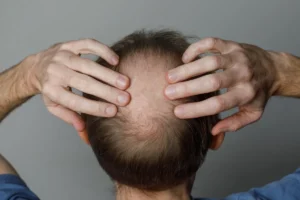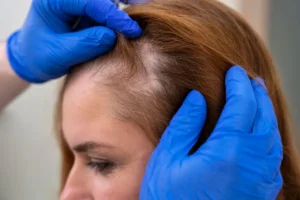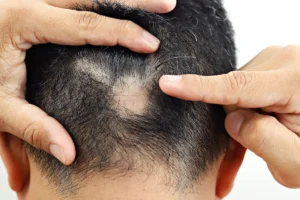
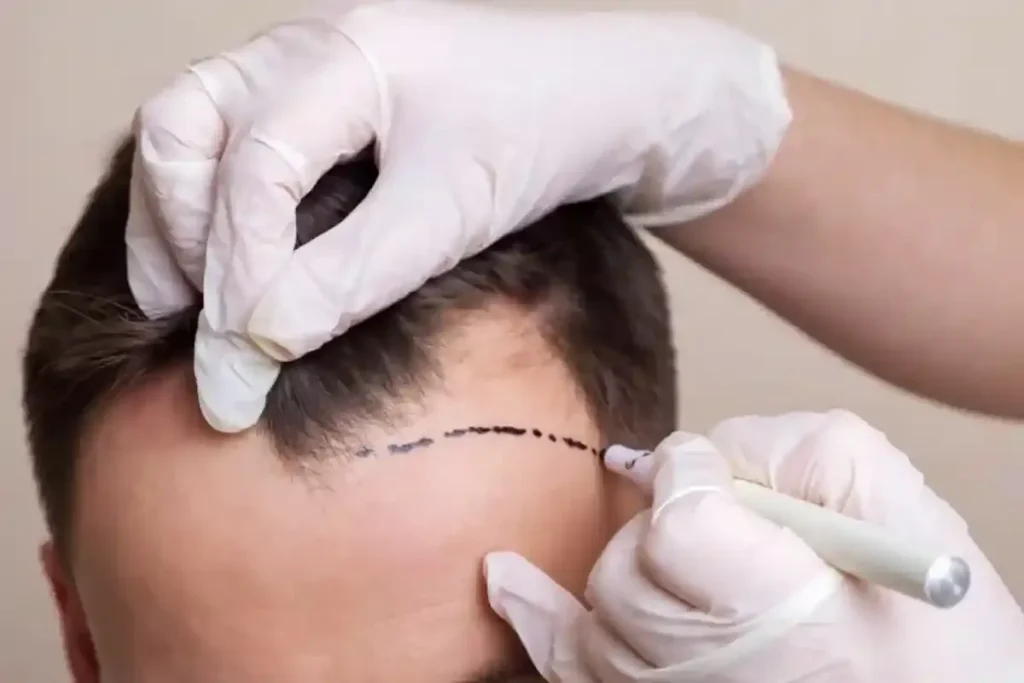
Seeing your hairline form an M shape can worry you. It’s important to know if it’s just a natural look or if it’s a sign of androgenetic alopecia early on.
A hairline that recedes and forms an M-shaped pattern is a common sign of balding. It affects up to 50 percent of males and females who start losing hair after puberty.
It’s key to understand the signs of M-shaped hairline loss to act early. This condition is caused by genetics and sensitivity to dihydrotestosterone (DHT).
Belangrijkste opmerkingen
Spotting early signs of M-shaped hairline loss can help stop it from getting worse.
A receding hairline in an M shape often means you’re losing hair due to androgenetic alopecia.
Genetics and DHT sensitivity play a big role in M-shaped hairline loss.
Acting quickly is important to manage hair loss.
Knowing your hairline pattern helps spot signs of hair loss early.
Understanding M Shape Hair Loss
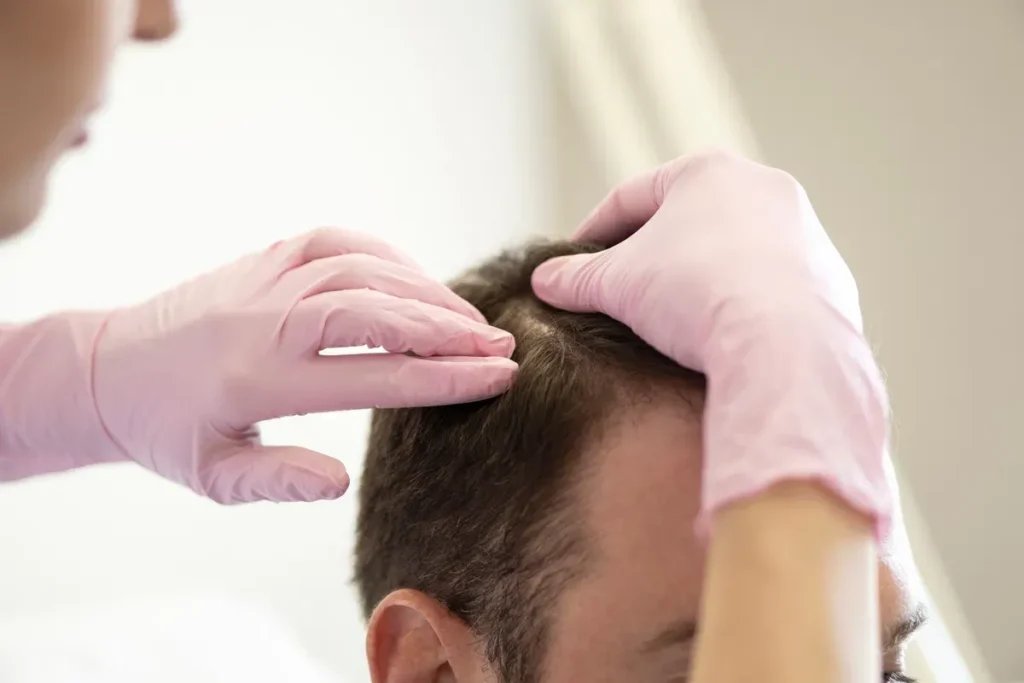
To understand M-shaped hair loss, we need to look at DHT and follicular miniaturization. This type of hair loss makes the hairline recede, forming an ‘M’ shape. It’s common in people with androgenetic alopecia.
The Science Behind DHT and Follicular Miniaturization
Dihydrotestosterone (DHT) is a key player in M-shaped hairline loss. It’s a byproduct of testosterone. When DHT binds to androgen receptors in hair follicles, it causes follicular miniaturization. This means the follicles shrink, leading to thinner, shorter hairs.
This miniaturization is a major reason for androgenetic alopecia. It results in the M-shaped hairline. Hair follicles are very sensitive to DHT. This makes it important to know how hormones and genetics work together.
Genetic Factors in M-Shaped Hairline Development
Genetics play a big role in M-shaped hairlines. If your family has a history of androgenetic alopecia, you’re more likely to get it. The genes affect how sensitive hair follicles are to DHT, making the condition worse.
Genetic Sensitivity: Increased sensitivity to DHT due to genetic factors.
Family History: A history of androgenetic alopecia in the family increases the risk.
Hormonal Influence: The role of DHT in follicular miniaturization.
Knowing about these factors helps people find the right treatments and prevention for M-shaped hairline loss.
Recognizing the Signs of M-Shaped Hairline Patterns

Spotting the early signs of an M-shaped hairline is key to fighting hair loss. This pattern shows as a receding hairline that looks like an ‘M’, mainly due to hair loss at the temples.
Male Pattern: Temporal Recession Creating the M Shape
In men, the M-shaped hairline comes from temporal recession. This is when the hairline pulls back from the temples, making an ‘M’ shape. It’s often linked to androgenetic alopecia, or male pattern baldness.
How fast this recession happens can vary. It usually starts with a slight pull back at the temples. Over time, it forms the ‘M’ shape.
Female Pattern: How M-Shaped Hairlines Differ in Women
Women with androgenetic alopecia tend to see diffuse thinning across the crown, not just at the temples. But, some women might get an M-shaped hairline too, with less noticeable recession at the temples.
Female hair loss can also show up as a triangle hairline or overall thinning. It’s not always a clear ‘M’ shape.
Age-Related Progression: From Early Signs to Advanced Stages
Age plays a big role in how fast an M-shaped hairline loss gets worse. Knowing how it changes with age helps spot it early. This way, you can get help sooner.
Knowing about these patterns and how they change with age helps. It lets people act fast to slow down or stop hair loss.
Conclusion: Effective Solutions for Managing M-Shaped Hairline Loss
Dealing with an m shape hairline or m hair line means looking into different treatments. Medicines like Finasteride and Minoxidil help hair grow and slow down loss. This is good for those with an m-shaped hairline.
For severe m shape baldness, hair transplant surgery is a lasting fix. It moves healthy hair follicles to thin spots. This makes the hairline look natural again.
Scalp micropigmentation is another non-surgical choice. It makes hair look fuller, hiding a thinning hairline. This is great for those who don’t want surgery.
Knowing about these options and talking to experts helps. People can choose the best way to care for their hair. This way, they can feel more confident and look radiant.
FAQ
What is an M-shaped hairline?
An M-shaped hairline is a type of hair loss. It forms an M shape at the front of the head. This usually happens because of genetics and sensitivity to DHT.
What causes M-shaped hairline loss?
M-shaped hairline loss is mainly due to genetics and DHT. DHT affects hair follicles, causing them to shrink and hair to thin.
How does M-shaped hairline loss differ between men and women?
Men’s M-shaped hairline loss shows as a receding hairline from the temples. Women’s hair loss is more about thinning all over, not just a specific M shape.
What are the early signs of M-shaped hairline loss?
Early signs include an uneven hairline or thinning at the temples. If not treated, it can get worse.
How does age affect M-shaped hairline loss?
As people get older, hair loss gets more noticeable. It’s important to start treating it early.
What treatment options are available for M-shaped hairline loss?
Treatments include medical options to grow hair or slow loss. There are also surgical choices like hair transplantation. Non-surgical options include scalp micropigmentation.
Can M-shaped hairline loss be prevented?
While genetics are a big factor, being aware and proactive can help. This can slow down the loss before it gets worse.
What is the role of DHT in M-shaped hairline loss?
DHT, a byproduct of testosterone, shrinks hair follicles. This leads to miniaturization and hair loss over time.
Is hair transplantation a viable option for M-shaped hairline loss?
Yes, hair transplantation is a surgical option. It moves healthy hair follicles to thin areas, making the hairline look natural again.
Wat is micropigmentatie van de hoofdhuid?
Scalp micropigmentation is a non-surgical treatment. It tattoos the scalp to make it look fuller. It’s a good option for those who don’t want surgery.
Referenties
National Center for Biotechnology Information. Evidence-Based Medical Insight. Retrieved from https://pubmed.ncbi.nlm.nih.gov/10586281/