
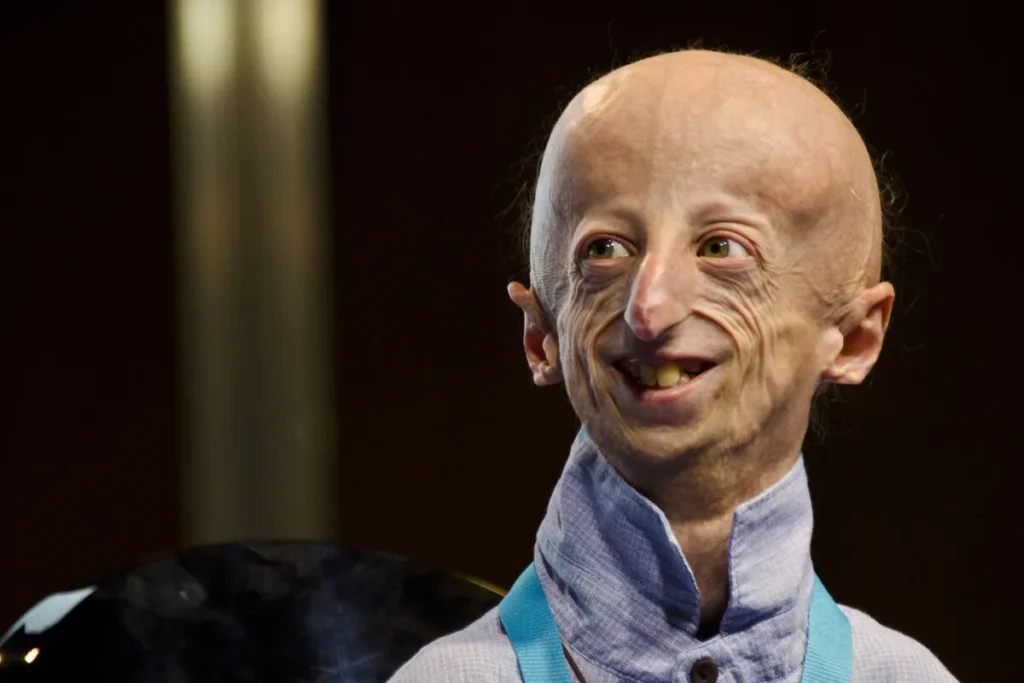
Progeria, also known as Hutchinson-Gilford syndrome (HGPS), is a rare and severe genetic disorder. It causes children to age quickly. This ultra-rare premature aging condition affects about 1 in 4 million newborns worldwide. Around 300 to 400 children live with it globally.
Children with Progeria seem normal at birth but start aging fast within two years. They may lose hair, have wrinkled skin, stiff joints, and heart problems. Yet, they usually have normal brains and can learn like other kids.
Belangrijkste opmerkingen
Progeria is a rare genetic disorder causing rapid aging in children.
It affects approximately 1 in 4 million newborns worldwide.
Children with Progeria have normal intellectual development despite physical challenges.
Progeria is also known as Hutchinson-Gilford syndrome or Benjamin Button disease.
Symptoms include hair loss, wrinkled skin, and cardiovascular disease.
Progeria: A Rare Premature Aging Condition

Progeria, also known as Hutchinson-Gilford Progeria Syndrome, is a rare genetic disorder. It causes children to age prematurely. This leads to many physical and medical problems.
Definition and Prevalence
Progeria is caused by a single point mutation in the LMNA gene. This mutation results in an abnormal protein called progerin. This protein makes cells unstable, speeding up aging in those affected.
This condition is very rare. It affects about 1 in 4 million to 1 in 8 million births worldwide. It doesn’t matter where you’re from or what your ethnicity is.
Historical Background and Discovery
Progeria was first described by Medical Expert 1886. Later, Medical Expert 1904. This led to the condition being named after them.
Discovering the genetic cause of Progeria has been key. Research found that a LMNA gene mutation leads to progerin. This disrupts normal cell function.
Knowing the history and genetics of Progeria helps in finding treatments. It also improves the lives of children with this condition.
Causes and Mechanisms of Accelerated Aging

Progeria causes cells to age fast because of a LMNA gene mutation. This mutation makes a harmful protein called progerin. Progerin builds up in cells and messes with how they work.
The LMNA Gene Mutation
The LMNA gene helps make proteins needed for cell health. In progeria, a special mutation makes progerin, a bad version of one of these proteins.
This mutation often happens by chance early in a baby’s development. It’s not passed down from parents in most cases.
Progerin and Cellular Damage
Progerin messes with cell structure, causing many problems. These include:
DNA damage and genomic instability
Disrupted cell division and growth
Altered gene expression
Increased cellular stress and apoptosis
Progerin is harmful to cells, harming blood vessels in particular. This leads to the vascular issues seen in progeria.
Inheritance Patterns
Progeria is not inherited in the usual way, even though it’s caused by a dominant mutation. It usually happens by chance in reproductive cells or early in fetal development.
So, kids with progeria seem fine at first. Symptoms start to show up in the first few months to two years of life.
Clinical Features, Diagnosis and Management
Progeria shows many symptoms, from growth failure to serious heart problems. Kids with Progeria face severe cardiovascular complications. This includes atherosclerosis, where arteries harden and narrow.
Characteristic Symptoms and Progression
Children with Progeria show signs like growth failure, hair loss, and heart disease. These symptoms get worse fast, causing early aging and other health issues.
Growth failure and delayed development
Hair loss and alopecia
Cardiovascular disease and atherosclerosis
Skeletal abnormalities and joint issues
Diagnostic Methods
To diagnose Progeria, doctors look for clinical signs and do genetic testing for the LMNA mutation. Finding the disease early is key to managing it well.
Clinical evaluation of characteristic symptoms
Genetic testing to confirm LMNA mutation
Cardiovascular assessment to monitor disease progression
Current Treatment Approaches and Research
Today’s treatments, like lonafarnib (ZOKINVY), help manage symptoms and improve life quality. Research is ongoing to find new treatments and better outcomes for Progeria kids.
Treatment options include:
Lonafarnib (ZOKINVY) to improve cardiovascular health
Physical therapy to maintain mobility and strength
Ongoing monitoring and management of cardiovascular complications
It’s vital to keep researching progeria for new treatments. Scientists are working hard to find better ways to help these children.
Conclusie
Progeria, also known as Hutchinson-Gilford syndrome, is a rare genetic disorder. It causes children to age prematurely. This condition leads to many physical and medical problems.
These problems greatly affect the quality of life for children and their families. There is no cure for Progeria yet. But, new treatments are helping manage symptoms and improve life quality.
Research and treatment advances offer hope for better outcomes. Understanding Progeria is key to providing the best care for affected children. By recognizing the challenges of this condition, we can help improve their lives and those of their families.
FAQ
What is Progeria?
Progeria, also known as Hutchinson-Gilford Progeria Syndrome, is a rare genetic disorder. It causes children to age quickly. This leads to many physical and medical problems.
How common is Progeria?
Progeria is very rare. It affects about 1 in 4 million children worldwide.
What causes Progeria?
A mutation in the LMNA gene causes Progeria. This gene codes for the lamin A protein. The mutation leads to progerin, an abnormal protein that harms cell function.
What are the symptoms of Progeria?
Children with Progeria often have growth failure and hair loss. They also have wrinkled skin, joint stiffness, and heart disease.
How is Progeria diagnosed?
Doctors diagnose Progeria by looking for signs and doing genetic tests. They check for the LMNA gene mutation.
What is the current treatment for Progeria?
Doctors use treatments like lonafarnib to manage symptoms. This helps improve the quality of life for children with Progeria.
Is Progeria inherited?
Progeria is not usually passed down in families. It happens when there’s a spontaneous mutation in the LMNA gene.
What is the life expectancy for children with Progeria?
Children with Progeria usually don’t live past their teens. Heart problems are a big reason for this.
What research is being done to treat Progeria?
Researchers are working hard to find new treatments. They want to slow or stop the disease’s progress.
What is progerin?
Progerin is an abnormal protein from the LMNA gene mutation. It builds up in cells and causes them to age quickly.
How does Progeria affect intellectual development?
Children with Progeria usually have normal intelligence. They are often bright, engaging, and mature, despite their physical issues.
Referenties
Nationaal Centrum voor Biotechnologie-informatie. Evidence-Based Medisch Inzicht. Opgehaald van https://www.ncbi.nlm.nih.gov/books/NBK1121/