In recent years, stem cells baldness treatment has moved from experimental labs to clinical practice, offering a promising alternative for those struggling with hair loss. As the demand for effective, minimally invasive solutions grows, more patients are asking whether this approach can truly restore thinning hair and improve confidence.
Worldwide, over 30 million men and women experience noticeable hair thinning by the age of 35, and the numbers rise sharply after 50. Traditional options such as medication or surgical transplants often come with limitations, side effects, or long recovery periods. Stem cell‑based therapies aim to address the root cause by stimulating natural hair growth cycles, potentially delivering lasting results with fewer complications.
This article will explain the science behind stem cell hair restoration, walk you through the typical procedure, discuss benefits and risks, outline costs, and highlight why Gold City Medical Center is uniquely positioned to deliver this cutting‑edge treatment.
Stamceltherapie voor haaruitval begrijpen
Stem cell therapy for hair loss leverages the regenerative capacity of undifferentiated cells to repair or replace damaged hair follicles. The most common source is autologous adipose‑derived stem cells, harvested from the patient’s own body fat, which reduces the risk of immune rejection.
Once isolated, these cells are concentrated and injected into the scalp where they release growth factors, cytokines, and extracellular vesicles—often referred to as exosomes—that signal dormant follicles to re‑enter the growth phase. This process is sometimes described using terms like stem cell hair restoration or stem cell therapy for hair loss.
- Stem cell hair treatment: Uses a patient’s own stem cells to stimulate hair follicles.
- Exosomes for hair: Tiny vesicles that carry regenerative signals to the scalp.
- Hair loss stem cell injection: The method of delivering concentrated cells directly into the scalp.
| Component | Function | Typical Source |
|---|---|---|
| Adipose‑derived stem cells | Promote follicle regeneration | Patient’s abdominal fat |
| Exosomes | Deliver growth factors | Processed from stem cells |
| Platelet‑rich plasma (optional) | Enhance healing | Patient’s blood |
How the Treatment Works: Procedure and Timeline
The typical stem cells baldness treatment protocol consists of three main phases: harvesting, processing, and injection.
1. Harvesting
Under local anesthesia, a small amount of fat (about 30‑50 ml) is gently suctioned from the abdomen or thigh using a sterile cannula. The procedure takes roughly 30‑45 minutes and is comparable to a routine liposuction session.
2. Processing
The harvested tissue is transferred to a certified laboratory where it undergoes centrifugation and filtration to isolate the stem cell‑rich fraction. This step usually lasts 60‑90 minutes. Some clinics also enrich the product with exosomes or platelet‑rich plasma to boost efficacy.
3. Injection
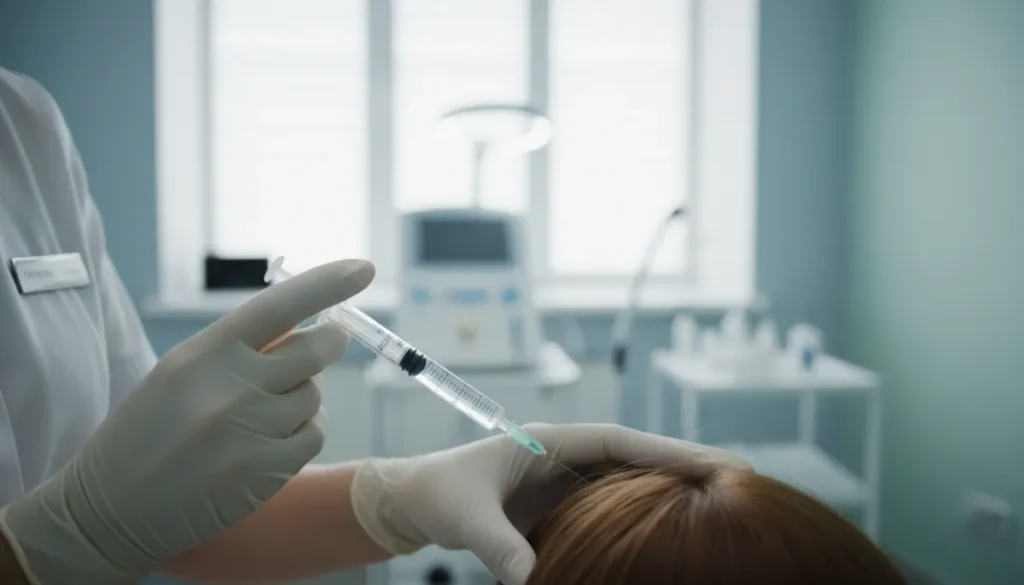
Using a fine‑gauge needle, the concentrated stem cells are injected into the scalp at strategic points where hair thinning is most evident. The entire injection phase typically requires 20‑30 minutes. Patients may experience mild redness or swelling, which usually resolves within a day.
A typical treatment plan includes 2‑3 sessions spaced 4‑6 weeks apart. Visible improvement often begins 3‑4 months after the final session, with optimal results seen at 9‑12 months as new hair shafts mature.
- Session length: 1.5‑2 hours total
- Recovery: Minimal downtime, normal activities resumed same day
- Follow‑up: Photographic documentation at 3, 6, and 12 months
Benefits, Risks, and Expected Results
When compared with traditional hair transplants, stem cell hair therapy offers several distinct advantages. Because the cells are autologous, the risk of allergic reaction is virtually eliminated. The procedure is minimally invasive, leaving no linear scars, and the recovery period is short.
Potential benefits include:
- Natural‑looking hair regrowth that blends with existing strands
- Improved scalp health due to anti‑inflammatory properties of stem cells
- Possibility of treating diffuse thinning, not just localized bald patches
Risks are generally mild and may include temporary redness, swelling, or bruising at the harvest site. As with any procedure that manipulates cells, there is a theoretical risk of infection, but strict aseptic protocols keep this incidence below 0.5 %.
Clinical studies report that 60‑70 % of patients observe measurable hair density increase after a full treatment course. Results vary based on age, degree of hair loss, and individual biology. It is important to set realistic expectations: stem cell therapy revitalizes existing follicles rather than creating brand‑new ones, so the degree of regrowth may be modest for advanced baldness.
| Aspect | Stem Cell Therapy | Traditional Transplant |
|---|---|---|
| Invasiveness | Minimaal invasief | Surgical strips or follicles |
| Littekenvorming | None visible | Linear or dot scars |
| Recovery Time | 1‑2 days | 1‑2 weeks |
| Applicability | Diffuse thinning, early‑stage loss | Localized bald patches |
Cost, Availability, and Choosing a Provider
Pricing for stem cell hair restoration varies based on the number of sessions, the volume of harvested fat, and any additional enhancements such as exosome enrichment. In the Netherlands, the average cost per session ranges from €3,500 to €5,500, with a typical full course costing between €9,000 and €15,000.
When evaluating providers, consider the following criteria:
- Medical credentials: Look for board‑certified dermatologists or plastic surgeons with specific training in regenerative medicine.
- Facility accreditation: Ensure the clinic follows ISO‑standard sterilization and has an on‑site laboratory for cell processing.
- Patient outcomes: Request before‑and‑after documentation and ask about long‑term follow‑up protocols.
- Transparency: Clear breakdown of fees, number of sessions, and any ancillary costs.
Gold City Medical Center meets all these standards, offering a fully integrated pathway from harvesting to injection within a single, patient‑focused environment.
Future Developments and Emerging Research
Research into hair‑regenerating stem cells continues to accelerate. Recent studies explore the combination of induced pluripotent stem cells (iPSCs) with bio‑engineered scaffolds to create fully functional hair follicles in the laboratory. While still experimental, early animal trials have shown promising hair shaft formation.
Another exciting avenue is the use of exosomes for hair growth. These nano‑vesicles can be harvested from stem cells and applied topically or via micro‑needling, potentially simplifying the procedure and expanding accessibility.
By 2025, several clinical trials are expected to publish results on the long‑term durability of stem cell‑based hair restoration, which may lead to insurance coverage and broader adoption across Europe.
Patients interested in staying at the forefront of hair regeneration should discuss emerging options with their clinician and consider enrolling in approved studies when appropriate.
Why Choose Gold City Medical Center
Gold City Medical Center combines a multidisciplinary team of experienced dermatologists, plastic surgeons, and regenerative‑medicine specialists to deliver personalized stem cells baldness treatment. Our on‑site laboratory ensures rapid processing of autologous stem cells, minimizing storage time and preserving cell viability. With a focus on safety, evidence‑based protocols, and patient comfort, we provide a seamless experience from consultation to post‑treatment follow‑up.
Ready to explore a regenerative solution for hair loss? Contact Gold City Medical Center today to schedule a confidential consultation and discover how stem cell therapy can revitalize your confidence.
FAQ
What is stem cells baldness treatment and how does it work?
It uses a patient’s own stem cells, usually from abdominal fat, to stimulate dormant hair follicles and promote new growth.
What are the benefits of stem cell hair therapy compared to traditional transplants?
It is less invasive, leaves no linear scars, offers quicker recovery, and can treat diffuse thinning.
What are the risks and possible side effects of stem cell hair restoration?
Side effects are usually mild, such as temporary redness, swelling, or bruising, with a very low infection risk.
How many sessions are required and what is the typical timeline for results?
Most patients undergo 2‑3 sessions spaced 4‑6 weeks apart, with visible improvement after 3‑4 months.
How much does stem cell hair restoration cost in the Netherlands?
A single session costs €3,500‑€5,500, with a full course ranging from €9,000‑€15,000.
How can I choose a reputable provider for stem cell baldness treatment?
Look for board‑certified specialists, ISO‑accredited facilities, transparent pricing, and documented patient outcomes.





